Detty December: Nigeria’s Most Powerful Untapped Cultural and Economic Asset
INSIGHTS
Mayowa Onare
1/12/20265 min read

Detty December has evolved into one of Africa’s most visible cultural phenomena. What began as a festive homecoming season has matured into a globally recognized signal of Nigeria’s cultural relevance, creative dominance, and diaspora pull. Each December, Lagos and an increasing number of Nigerian cities become focal points of global cultural attention, drawing international visitors, diaspora returnees, artists, investors, and media. The scale, consistency, and organic growth of this phenomenon place it firmly alongside the world’s most influential cultural tourism moments.
Despite this visibility, Detty December remains largely unmanaged as a national economic asset. Activity surges sharply, yet institutional value creation remains limited. The result is a recurring cycle of peak excitement, congestion, and short-term spending without durable gains in tourism infrastructure, fiscal capture, or long-term economic positioning. This gap represents one of the most immediate and addressable opportunities within Nigeria’s culture and tourism agenda.
Cultural Demand Is No Longer in Question
The demand signal behind Detty December is clear and sustained. International arrivals into Lagos rise sharply during December, hotel occupancy reaches near-capacity levels, and short-term rentals command premium pricing across major districts. Entertainment venues, beach destinations, event spaces, transport providers, and hospitality operators experience volumes comparable to major global festival cities. Digital and social media amplification generates hundreds of millions of impressions annually, positioning Nigeria prominently in global cultural conversations without formal state-led marketing campaigns.
Few countries achieve this level of international cultural pull organically and repeatedly. Nigeria does so every year, driven by its creative industries, diaspora networks, and cultural credibility. The strategic question is therefore not whether demand exists, but whether that demand is being converted into sustained national value.
Economic Value Is Being Captured Poorly
While Detty December generates substantial short-term cash flows, very little of that activity translates into long-term economic or institutional value. Spending concentrates within a narrow time window and dissipates almost immediately after the season ends. Data on visitor numbers, spending patterns, safety incidents, and sectoral impact remains fragmented or informal, limiting the ability of policymakers to plan infrastructure, assess fiscal returns, or justify targeted investment.
Much of the upside is absorbed informally, while the public sector bears the costs associated with congestion, security pressure, transport strain, and emergency response. Without structured coordination, Nigeria absorbs the pressure of success without capturing its full economic dividend. In practical terms, Detty December functions as a recurring shock to the system rather than a managed growth platform.
A Strategic Reframe Is Required
Detty December should be approached not as a festive period, but as cultural infrastructure. Globally, successful tourism economies do not treat peak events as isolated celebrations. They build systems around them to anchor year-round value creation. Carnival in Brazil, Fashion Week in Paris, and major arts festivals in North America operate as platforms that drive sustained tourism flows, creative exports, investment attraction, and employment pipelines far beyond their headline dates.
Nigeria’s Detty December already possesses comparable cultural gravity. What it lacks is formal orchestration, measurement discipline, and policy alignment. With the right structure, Detty December can function as a flagship national tourism product, a gateway into year-round leisure and cultural tourism, a structured diaspora engagement mechanism, and a scalable platform for youth employment and creative industry growth.
Immediate Policy Levers Exist
This opportunity does not require reinvention or heavy capital outlay. It requires coordination, clarity, and execution discipline. Formal designation of Detty December as a national tourism season would enable defined objectives, performance indicators, and cross-agency planning. A centralized data and analytics framework would allow accurate measurement of visitor flows, spending behavior, safety trends, and economic impact across states.
Coordinated public-private planning would align transport, security, licensing, sanitation, and infrastructure investment with predictable seasonal demand. Critically, Detty December programming must be explicitly linked to creative industry development, export promotion, and post-season employment pathways so that momentum generated in December compounds rather than evaporates in January.
The Strategic Risk of Inaction
If left unmanaged, Detty December will continue to grow, but in an increasingly fragile manner. Rising costs, infrastructure strain, inconsistent visitor experience, and safety concerns risk eroding the very reputation that fuels the season’s success. At the same time, competing African and global destinations are investing deliberately in cultural tourism strategies and can replicate Nigeria’s model with stronger institutional backing.
Nigeria currently holds first-mover advantage in this space. That advantage will not persist indefinitely without strategic stewardship.
Turning Cultural Energy Into National Capability
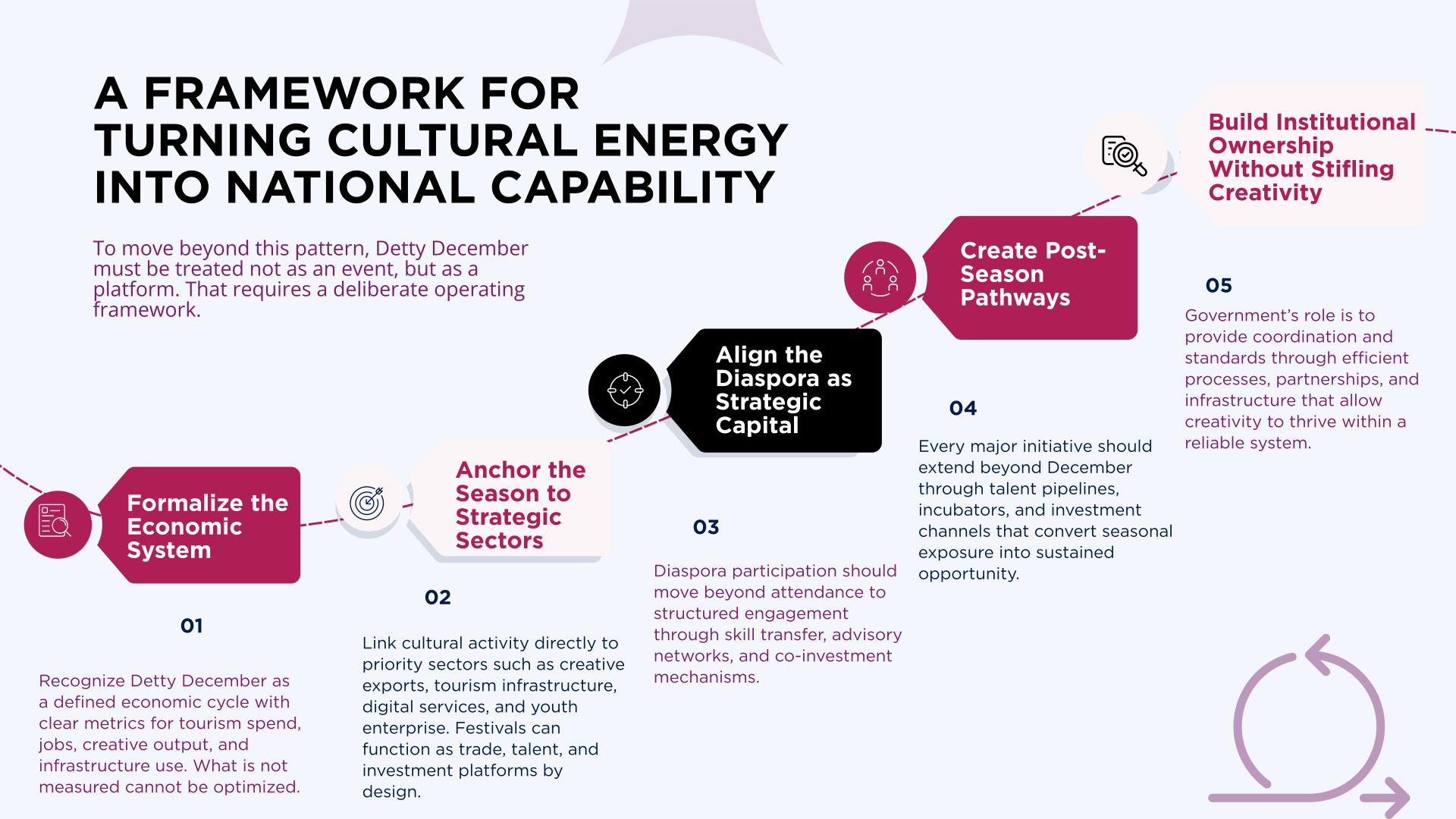
Moving beyond the current cycle requires treating Detty December not as an event, but as a platform. Platforms create repeatable value because they are designed with operating frameworks, ownership models, and measurable outcomes. Without this shift, Nigeria will continue to generate cultural energy without converting it into national capability.
The first requirement is formalizing the economic system around Detty December. The season should be recognized as a defined economic cycle with measurable inputs and outputs. Tourism spend, employment creation, creative exports, transport load, infrastructure utilization, and public revenue capture must be tracked systematically across federal and state levels. What remains informal cannot be optimized, scaled, or defended in policy and budget decisions.
Second, Detty December must be deliberately anchored to strategic sectors rather than treated as standalone entertainment. Cultural programming can serve simultaneously as trade showcases, talent marketplaces, and investment forums when intentionally linked to creative exports, digital services, tourism infrastructure, hospitality supply chains, and youth enterprise. This linkage is what converts cultural expression into economic leverage.
Third, institutional ownership must be established in a way that strengthens the system without suppressing creativity. Government’s role is not to curate culture, but to coordinate the environment in which it thrives. Streamlined permitting, safety standards, transport planning, export facilitation, and public-private partnerships provide stability and confidence for operators while preserving the organic energy that makes Detty December authentic.
Fourth, post-season pathways must be designed before the season begins. Every major initiative activated in December should have a January strategy, including incubators for creatives identified during the season, workforce pipelines tied to hospitality and logistics, and structured vehicles for channeling diaspora capital into productive enterprises. Momentum that is not captured immediately is almost always lost.
Finally, diaspora engagement must mature from emotional participation to structured contribution. The return of Nigerians abroad represents not only spending power, but skills, networks, and capital that can be institutionalized through advisory networks, co-investment platforms, short-term return fellowships, and sector-specific skill transfer programs. Seasonal presence should translate into durable institutional impact.
From Moment to Legacy
Detty December has already proven that Nigeria can attract global attention, mobilize capital, and inspire its youth at scale. That achievement places the country in a rare global category. However, leadership is measured not by what a system can ignite, but by what it can sustain.
The question is no longer whether Detty December works. The evidence is clear. The question is whether leadership is willing to do the harder work of converting cultural momentum into enduring national capability. If that choice is made, December will no longer function as a peak, but as a foundation. That is the difference between a season that entertains and a system that builds.
Related Insights
White-Glove Consulting
If this perspective surfaced a challenge you are navigating, or a question worth acting on, Orun Group works with leaders to translate insight into clear, executable outcomes.
Connect with Orun Group to explore a tailored engagement designed around your priorities, context, and pace of change.
© 2026 Orun Group. All rights reserved.